
What It Is
The Internal Service Brief carries the context Delivery cannot get from the proposal or Productive on its own — why the client bought, what was promised, what to be careful about.
It is written by the salesperson, reviewed by the salesperson, and read by Delivery before the handoff conversation. Delivery does not co-author it.
Start with the approved proposal
Add relevant sales correspondence or notes, plus your own commentary for anything the proposal does not make obvious.Draft it with AI
Give it the template below and your source material. It produces the first version.Review and correct it
You are accountable for what the brief says. An unreviewed draft is not a handoff.Export a one-page PDF and attach it to Productive
Where Delivery will look for it. The handoff conversation follows, with the brief as the agenda.
The Template
This is the reference layout and the level of detail expected. The example is fictional — an ordinary retained client, filled in the way a real one should be.
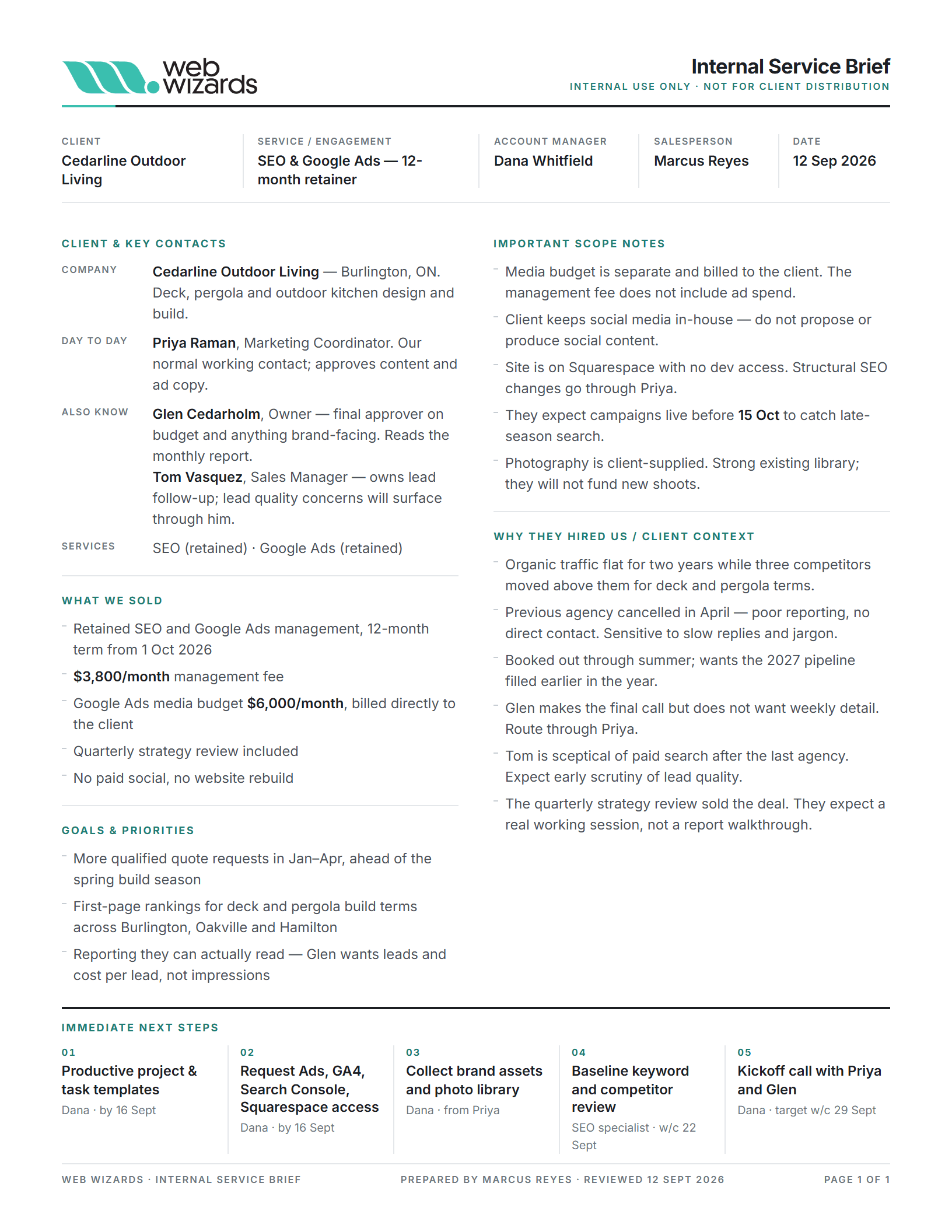
Download
Internal Service Brief — template & worked example
One page, US Letter, PDF.
What Goes In Each Section
Header fields first — client, service or engagement, Account Manager, salesperson, date — then the six sections below.
- Client & key contacts
- Company, Account Manager, assigned services. Name the primary working contact — who we deal with day to day — separately from other stakeholders or influencers: executive sponsor, owner, final approver, marketing lead. Not a contact list; only people Delivery needs to know about.
- What we sold
- Services purchased, recurring or project, fee and budget where useful, term, expected start. Do not reproduce the proposal scope.
- Goals & priorities
- What the client is trying to achieve, in their words where possible. Do not invent KPIs nobody agreed to.
- Important scope notes
- Only what Delivery could miss or misread — inclusions, exclusions, assumptions, unusual requirements, timing commitments, dependencies, media budget versus management fee, and anything the client is keeping in-house.
- Why they hired us / client context
- The business problem or opportunity behind the engagement, and the context around it: prior agency experience, known frustrations, sensitivities, decision-making dynamics, internal constraints, expectations set during the sale. Only what materially affects delivery — no client history, no gossip, no personality profiling.
- Immediate next steps
- Three to five concrete actions with an owner: Productive setup, access requests, asset collection, baseline review, kickoff scheduling.
Producing One With AI
Five to ten minutes for a normal account. Give the model the template and the source material, then check what comes back.
- What to supply
- The PDF above as the layout and tone reference, the approved proposal, any sales correspondence that carries context, and your own notes on what the proposal does not say.
- What to ask for
- A one-page Internal Service Brief following the attached template, using only the supplied material. Tell it to leave a section short rather than filling it with inference.
- What to check
- Names, figures, dates and commitments against the proposal. Anything the model inferred rather than read. Whether it still fits on one page.
Then What?
The brief is step two of onboarding. The handoff process around it is in Client Onboarding.
- Internal HandoffWhat sales passes to delivery, in what format, and what delivery confirms before work starts.
- OverviewWho owns onboarding, what happens in what order, and what has to be true before delivery starts.
- Productive SetupSoonProject, budget, task template and time-tracking configuration in Productive.
- Brand, Document & Deliverable StandardsThe visual system, branding and ownership rules, and document conventions behind everything we produce.